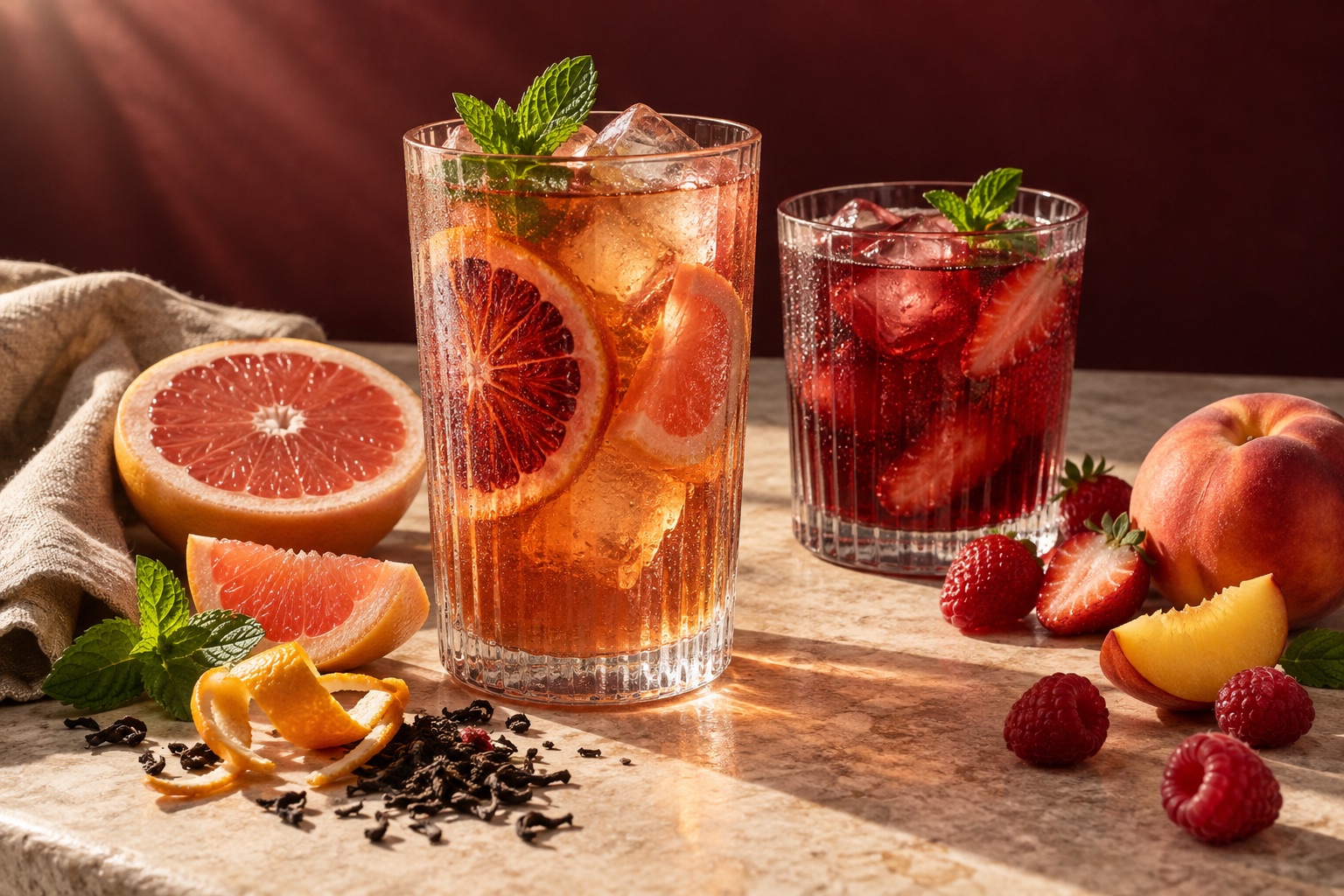
The ice does not tell you how the tea was brewed
A glass of iced fruit tea may begin with a hot infusion or with leaves steeped in cold water. “Iced” describes how you serve it; “cold-brewed” describes the preparation. For a home drink, the useful choice starts with the directions for your tea and the time you have.
Our editorial starting point: use a hot method when the package calls for it or you want to prepare the tea without a long refrigerator steep. Choose refrigerator cold brewing when the producer provides suitable cold-brew instructions and you can plan around them.
| Method | What to plan | Before adding fruit |
|---|---|---|
| Hot brew, then chill | The package’s water temperature and steep time, plus cooling. | Remove the leaves or bag and account for any ice used to cool it. |
| Refrigerator cold brew | The producer’s cold-water dose and time; allow fridge space. | Strain at the instructed time and measure the tea portion. |
Hot brewing: plan the finished volume
Harney & Sons offers a hot-brewed iced-tea method that starts with half the usual water, then adds cold water and ice. That illustrates a concentrate approach: leave room for the water added later. It is the company’s method, not a universal ratio for every tea or fruit drink. Read Harney’s preparation guide ↗
For your own glass, count juice as part of the liquid you add after brewing. If you make a full glass of tea and then add juice and melting ice, you have changed the proportions. Decide whether your goal is a tea-forward drink or a lighter fruit drink before adjusting the next batch.
Cold brewing: use the instructions for that product
Harney’s same guide describes a refrigerator steep of 6–12 hours. Treat that as a published example, not a default timer for everything sold as tea. Use your product’s cold-brew directions for its amount, water volume and duration; do not transfer a hot-brew timer to cold water. See the refrigerator method ↗
Write the start time on a note so “overnight” becomes a repeatable interval. If the package only gives hot-water directions, our recommendation is to use those and chill the resulting tea, or ask the producer for a suitable cold method. A fridge steep is not permission to ignore a required heating step.
Dried fruit and herbal blends need a separate check
Tea leaves with fruit added after brewing are different from a dried fruit-and-herb infusion. Germany’s Federal Institute for Risk Assessment advises preparing herbal and fruit infusions with boiling water and at least five minutes of steeping, because the dry ingredients can carry microorganisms. Its guidance applies to loose blends and bags. Read BfR’s preparation guidance ↗
Check the complete blend and its preparation label. An ordinary hibiscus or dried-fruit bag should not acquire a cold-brew recipe simply because you want the final drink cold. Follow its hot preparation, then cool it promptly for iced serving.
Add fruit as a separate decision
Our suggestion for learning your preferences is to prepare the tea first, then add a measured amount of fruit or juice to the serving glass. This makes it easier to distinguish the tea’s character from the fruit addition. It also lets you try two fruit choices without committing the whole pitcher.
Handle the fruit separately and cleanly. The FDA recommends washing produce under running water before preparation, without soap, and keeping perishable produce such as berries at 40°F or below. It also calls for refrigeration of produce purchased pre-cut. Follow storage directions for packaged ingredients rather than assuming one shelf life for every finished fruit tea. See the FDA’s produce guidance ↗
Choose a method you can repeat
Keep a short record of the tea, method, water volume, steep time and fruit addition. When comparing two preparations, use the same fruit and final serving size. Describe what you notice rather than assuming cold brew must taste smoother or hot brew must taste stronger.
These are preparation choices and an editorial comparison idea, not a kitchen-tested recipe or a side-by-side product tasting.
Explore more field guides ↗